POP! PEP!

0d 0hrs
It all started with that “pop!”
The condom broke on a Saturday night, which felt almost cosmically unfair because Saturdays are supposed to be relaxing. Saturdays are for laundry, a good little nap, and, well, maybe a bit of casual fun with a hottie—but definitely not for sitting on a stranger’s dick in my bed and thinking:
Oh fuck.Oh fuck oh fuck oh fuck.
We both felt it, much more noticeable than I’d assumed, like a poor balloon puppy crashing into a needle. He and I froze immediately, but the damage, if there was any, was already done. You know that moment in horror films when the music stops and everyone holds their breath? Except more exposing and infinitely less cinematic.
“Did that just...”
“Yeah.”
“Shit.”
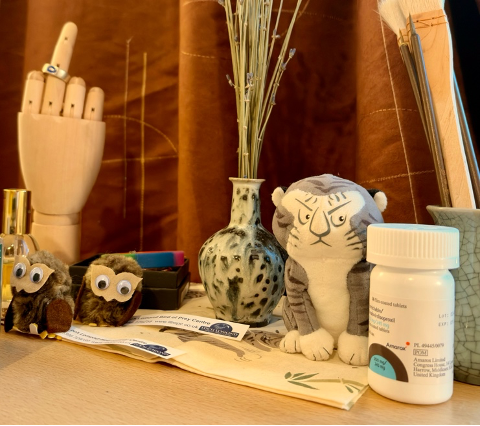
I turned my head towards the cabinet. There quietly sat the bottle of PrEP (Emtricitabine/ Tenofovir) I’d already opened. Four words were looping in my head: if I had known... I didn’t take it because, first, I knew I’d use condoms, and second, I wanted to treat my kidneys and
liver better. As an old Chinese saying goes, “是药三分毒” (every medicine has 30% poison).
Ironically, what should have been a three-day burden was now extending to 28 days. Exactly what I wanted :)
20 minutes later I was sitting on the edge of my bed, alone, Googling “PEP London.” I’d heard about PEP before, obviously. Post-exposure prophylaxis. The emergency brake for HIV. But I thought I’d never need it because I was careful. Yet now I had less than 72 hours to find help in London.
0d 18hrs
Dean Street Sexual Health Clinic sits in the heart of Soho, London’s historic gay district. I used to visit when I was younger—they have walk-in STI screening and PrEP service for LGBTQ+ people under 21. Thanks to this “pop,” I’d finally regained the privilege of receiving walk-in service at the age of 22.
I pushed through the doors with my heart hammering then stepped into a warmly bright, professional-looking space. Nothing about it screamed “crisis,” though that was exactly what brought me there.
“Hi, how can I help you?" The receptionist smiled as I approached.
“I need some PEP? The condom—”“Say no more, love.” She typed quickly. “You’re well within the window. The doctor will call out your name and see you shortly. We’ll get you sorted.”
We’ll get you sorted. God, I love British people sometimes.
The waiting area was calm, with some queer radio show playing in the background. I looked around. A few men sat scattered across the chairs, some scrolling through their phones, others staring at the void. Are we here for the same reason? Different reasons? There was something oddly comforting about our shared identity and vulnerability.
The doctor who saw me was maybe forty, with silver in his beard and a small rainbow badge pinned to his white coat. But more than the badge, I could tell he was family from the way he spoke to me—not with clinical detachment but a kind of gentle knowing, as someone who understood what I was going through.
“So, condom broke.”
“Yup.”
“Ahhh unfortunate. It happens sometimes. And you’re not on PrEP?”
“Not this time.”
Stop reminding me!
“I see. Your record shows you just got tested for STIs, so today we’ll just run a quick blood test before getting you on PEP.”
He explained the protocol with remarkable clarity: 28 days of antiretroviral drugs. One pill of Tenofovir/Emtricitabine, two pills of Raltegravir, once a day, same time, no exceptions. Blood tests before starting, then follow-up test six weeks after finishing.
“The side effects can be rough for some,” he warned. “Nausea, fatigue. But not everyone gets them badly. And it’s absolutely worth it. PEP is over 90% effective when taken correctly and started this early. But consistency is key.”
He stood up, led me to a small room with soft lighting. “Wow, pink walls huh?” I was surprised.“I know right? Isn’t it lovely?”
He got me to lie on a small bed and drew my blood while making gentle small talk about the weather, about what I did yesterday, trying to distract my attention from the needle going in. And I surely tried hard to get distracted by him.
“All done,” he said. “Here are the pills. Take care of yourself and make sure to book a follow-up appointment, ok?”
“But I won’t be around London by then. I’m going back to Beijing in weeks.”
“Well, in that case, you’ll need to do a check-up there.”
I walked out of Dean Street with medication in my hands. For free. Yeah, I’d paid thousands of pounds to the NHS, and it was time to give me back what I deserved. Right, now, 28 days of pills/ struggles ahead of me. But at least at this moment, I felt I was being cared for, efficiently and without shame.
I took the pills religiously, setting alarms on my phone I couldn’t ignore labelled “TAKE YOUR DAMN PILLS.” They made me tired. Not exhausted, but perpetually slightly fatigued, as though I’d slept an hour less than I needed. I felt a persistent low-grade nausea that made eating a negotiation with my stomach. Or maybe it was my brain manifesting all these symptoms, so I’d believe the drugs were doing their job in great uncertainty.
“New medication?” one friend asked during dinner. “Ugh...something like that.”
I mean, I wasn’t ashamed, but I also wasn’t ready to turn my PEP journey into dinner conversation. There’s a particular kind of queer oversharing that is liberating, but there’s also the version that turns your medical crisis into everyone else’s entertainment, and I wasn’t in the mood for the latter.
64d 5hrs
I returned to Beijing halfway through my PEP course. When the course ended, I needed the final test to confirm what I already hoped: that I was negative, that I could close this chapter and move on. In London, I would have simply returned to Dean Street. In Beijing, the process would be different.
I chose one of the city’s large public hospitals, a sprawling complex of buildings that serviced thousands of patients daily. I booked the appointment online and was pointed toward the sector of Dermatology and Sexually Transmitted Diseases. This seemed a brand-new combination of words to me.

The corridor outside the department teemed with people—patients waiting on chairs, family members standing in clusters, kids and seniors, men and women, people of all kinds. The white walls were plastered with public health posters: images and illustrations of genital warts, herpes lesions, all accompanied by bold text warning about transmission and treatment. HIV brochures were stacked in plastic holders, their covers featuring red ribbons and hotline numbers.
I took a ticket from the machine and sat down to wait, feeling somewhat embarrassed.
The consultation room doors were almost always half-open. Not wide open, not closed, just perpetually half-ajar, as if privacy were a suggestion rather than a requirement. Patients and family members walked in and out. I could hear fragments of conversations between doctors and patients, see people walking past and glancing inside.
At one point, while I was still waiting, an anxious-looking middle-aged man barged into one of the rooms without knocking, waving a paper. “Doctor! Doctor, I got my test result! Can you check it?” The doctor barely looked up. “Wait your turn! Can’t you see I’m seeing other patients?”
Welcome to big public hospitals in Beijing.
My number was finally called. I entered a small consultation room where a young female doctor sat behind a desk stacked with papers. She looked up, professional but harried, clearly managing too many patients in too little time.
“Where do you feel uncomfortable?” she asked, fingers poised over her keyboard.
“I’d like to be tested for HIV and other STIs,” I cleared my throat and said calmly, keeping my voice neutral.
“Why?” She didn’t ask this judgementally, I guess—just pragmatically.“I completed a course of PEP,” I explained. “So, I need to confirm my status.” She paused, fingers lifting from the keyboard.
“What’s PEP?”
I froze. Again. Stared at her.
Cameraman, dolly zoom my face please, with the focus on my big innocent eyes. I just didn’t know how to respond. Like, huh? Like, are you the doctor or am I the doctor? For a moment, I thought perhaps I’d misunderstood, that maybe the English acronym wasn’t familiar. I explained it as simply as I could: emergency treatment taken after potential exposure to prevent HIV infection.
She listened, nodding slowly, processing this like I’d just told her about some fascinating foreign custom, and then caught me with another question. “And why did you need that?”
“Girrrrl, why are you so curious???”
These were, of course, the words I screamed in my head. In reality, I said “I had a high-risk sexual behaviour. My condom broke.” ...“I see.” She said finally.
I was grateful she didn’t ask if it was with a man or woman, because I was sure the people outside could eavesdrop on our conversation. I’m proud of my identity yet exposing it in public can still be unwise in China, even though homosexuality has been decriminalised for more than twenty years. But maybe she didn’t ask because she assumed my sex was heterosexual? Now I feel a bit offended. Anyway, back to the consultation room.
“Well, ok, I know your situation now. I’ll test you for HIV and syphilis.” “What...what about the others?” I asked. “Chlamydia and Gonorrhoea?”
She waved a hand dismissively. “Those would have obvious symptoms. You don’t need those tests.”
I wanted to argue. I knew early asymptomatic infections exist. I knew that in London they would have tested me for everything as standard practice. But I could see the queue outside, could hear someone already knocking impatiently on the door, could feel the weight of a system that processed hundreds of patients daily.
“OK. HIV and syphilis then.”She printed the test orders. “Pay outside, then go to the testing centre on the ground floor.”
At the payment machine, the moment the fees appeared on the screen, I started to thank her.
100 yuan. For two tests.
I mean, it’s not a huge amount of money, but enough for groceries that can sustain a small family for a week. I understood then why the doctor had limited my tests. Not because she didn’t care, necessarily, but because the system operated on a completely different economic scale. In a healthcare system serving over a billion people with vastly less funding per capita than the NHS, comprehensive screening wasn’t the default, targeted testing based on specific risk was, whether that’s for sustaining the system or minimising individual burden.
I paid and went to get stabbed with a needle.
The testing itself was quick and anonymous, although happened in a giant hall with multiple sampling windows. One needle stick, two vials of blood. I forgot if the wait was an hour or 15 minutes because I felt like I sat in the waiting area for a year, with my anxiety creeping back, the anxiety of a disease that could force me into a precarious social situation and follow me for my lifetime. I knew that my risk had been low to begin with. But knowledge and feeling are different countries, and I spent those seconds, days, and weeks trapped between them.

When I finally scanned my receipt to get the result printed, I grabbed it but didn’t dare to look at it until I rushed outside, standing on the hospital steps in the afternoon sunlight.
HIV Antibody: Negative
Syphilis: Negative
I stood there in the golden light. Relief, yes, but also something else—gratitude, maybe. It was done. The 28 days plus six weeks, the anxiety, the fear—all resolved into two simple words.
Negative.Negative.
Two most beautiful words in any language.
Bibliography
World Bank (2026) Current health expenditure per capita (current US$) – China, United Kingdom [Data set]. Available at: https://data.worldbank.org/indicator/SH.XPD.CHEX.PC.CD?end=2025&locations=CN- GB&start=2000 (Accessed: 4 February 2026).
Zhang, J., Zhao, D. and Zhang, X. (2024) ‘China’s universal medical insurance scheme: progress and perspectives’, BMC Global and Public Health, 2(1), 62. doi:10.1186/s44263- 024-00096-9.


Comments